— Sevilfest journal
“SevilFest” in Sarajevo Film Festival
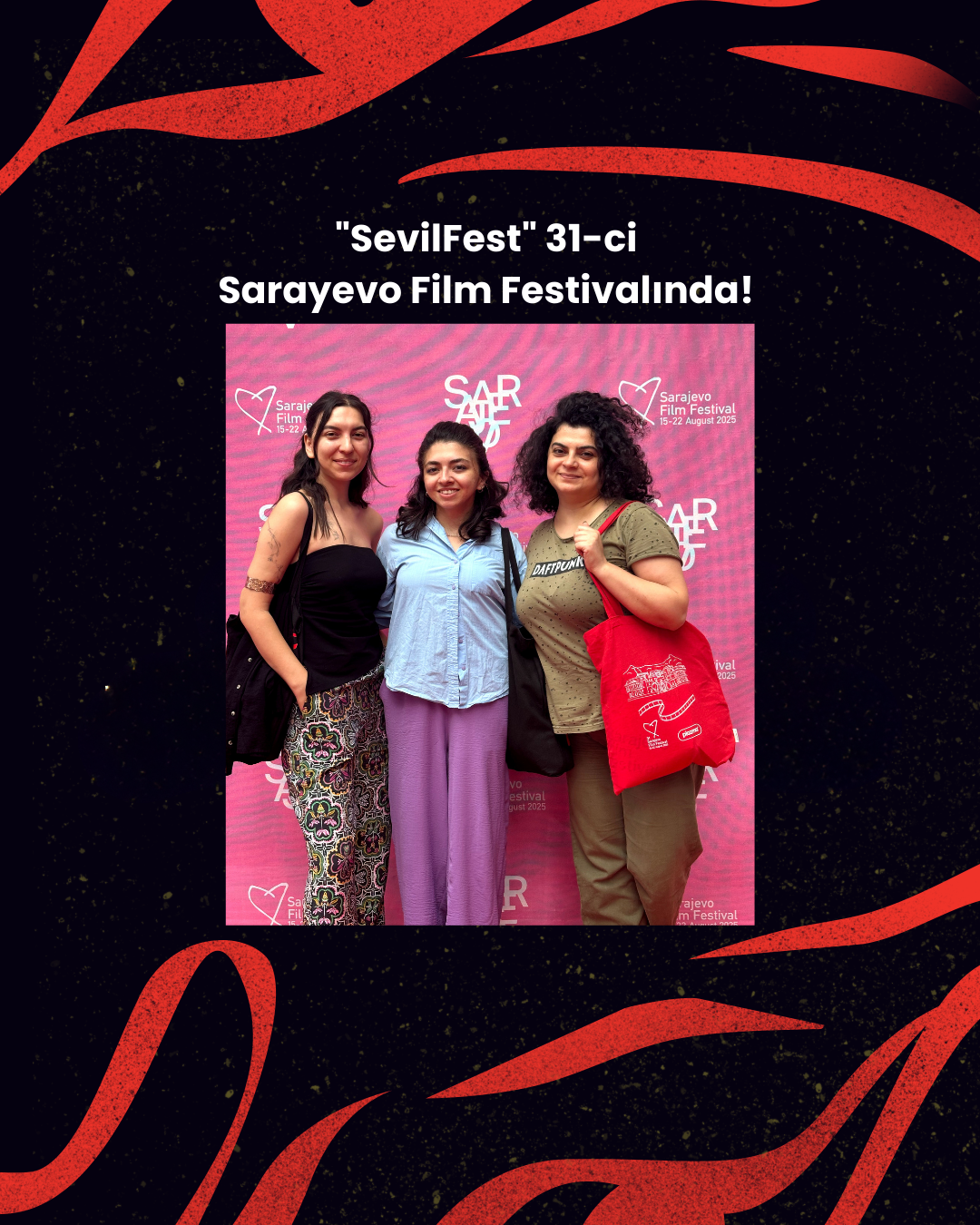
This year, the “SevilFest” team took part in one of Europe’s most significant film events — the Sarajevo Film Festival — with official festival accreditation. During the week when the entire city was immersed in a cinematic atmosphere, we attended various masterclasses, film screenings, and discussions.
The participation of the “SevilFest” team in Sarajevo became possible within the framework of solidarity and collaboration between festivals. This opportunity was supported by Rada Šešić, the curator of the documentary competition. It is worth noting that a month before Sarajevo, Rada Šešić had visited Baku as a guest of “SevilFest,” served as a jury member, and held a masterclass for the Azerbaijani audience.
History and significance of the festival
The history of the Sarajevo Film Festival is deeply moving both in terms of cinema and the region’s past. It was first held in October 1993, during the war and siege, as a ten-day “Sarajevo International Film Festival” organized by Haris Pašović. Its success, along with the wartime film screenings organized since 1992 by Mirsad Purivatra and Izet Građević, laid the foundation for the annual festival. As a result, in 1995, the Obala Art Center established the first official Sarajevo Film Festival.
At that time, the city was still under siege. Although a low turnout was expected, 37 films from 15 countries were screened, and 15,000 viewers attended. It was not only a film event but also a symbol of hope.
Over the years, the festival has grown rapidly into a major international event, attracting more than 100,000 viewers annually and showcasing hundreds of films from over 60 countries. In 2001, the European Film Academy recognized the Sarajevo Film Festival as one of 11 festivals authorized to nominate films for the “Best Short Film” category in Europe. In 2019, the Academy of Motion Picture Arts and Sciences designated it as an official qualifying festival for short films — meaning that winners of the “Heart of Sarajevo” award can be directly considered for an Oscar nomination. That same year, Sarajevo was also named a “City of Film” by UNESCO.
What happened this year?
Festival events took place both in indoor venues and open-air locations across the city. Entry was possible only with tickets, invitations, or accreditation. During the festival days, Sarajevo transforms into a city that lives and breathes cinema.
Held from August 15–22, this year’s edition featured 227 films from 65 countries. Among them, 50 films competed in four categories — feature, documentary, short, and student films — for the “Heart of Sarajevo” awards. The official selection included 15 world premieres, 6 international premieres, 28 regional premieres, and 2 national premieres.
Among the festival’s special guests were actors Willem Dafoe and Ray Winstone, as well as director Paolo Sorrentino, all of whom held masterclasses. Alongside them, Stellan Skarsgård received the festival’s Honorary Heart of Sarajevo Award.
Azerbaijani participation
One of the most notable aspects of the festival was the spontaneous and informal presence of the Azerbaijani film community in Sarajevo. This year, a total of 10 participants from Azerbaijan attended:
- The “SevilFest” team,
- Hilal Baydarov participated in the CineLink Industry Days with his new feature project Stone upon Stone and won the Montenegro Film Centre Award worth €10,000,
- Lala Aliyeva presented a documentary project at Docu Talents from the East,
- Nargiz Mammadli and Alemdar Faiq took part in Talents Sarajevo within the “Pack & Pitch” section with their documentary project Untitled Memory,
- Last year’s “Pack & Pitch” winners Durna Safarova and Atanur Nabiyeva,
- And Imam Hasanov, who competed in the feature documentary section with Dreamers: Children of Light.